What if Monet Had Stopped at 50?

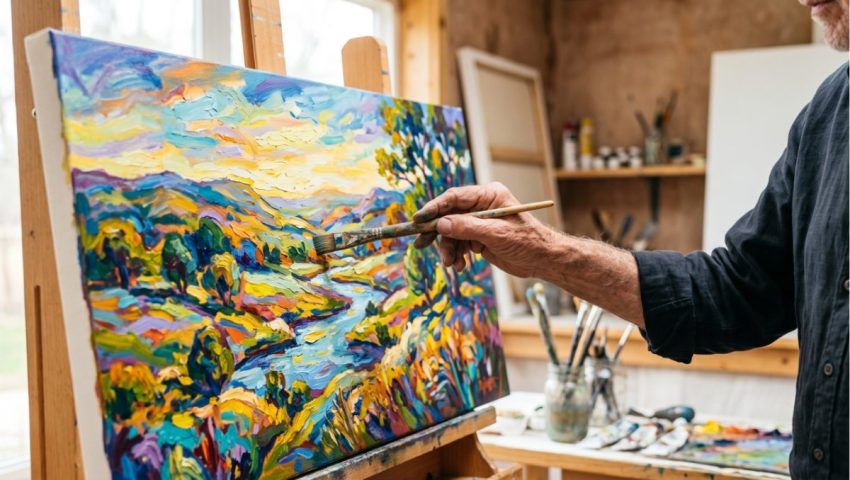
By 50, Claude Monet had already painted many of the works that would come to define Impressionism, and he still had four more decades of work ahead of him, including the water lily series that reshaped how a generation of painters thought about color and light. His practice didn’t plateau in middle age. It deepened.
Most artists don’t get four more decades to prove a point. But the question is worth asking anyway, because it exposes an assumption most people never examine: that a serious art career has to start young, run in a straight line, and belong to someone who never did anything else with their working life.
That assumption doesn’t hold up. A meaningful and growing number of artists come to the practice after 45, often after building an entire first career as a doctor, an architect, an engineer, a lawyer, an executive. They arrive with decades of discipline, resources, and life experience, and they’re often told, implicitly or explicitly, that they’re arriving too late. This piece is about why that’s the wrong way to think about it.
The Second-Career Artist Is Not a Niche Case
It’s easy to picture “the artist” as someone who committed to the practice at 22 and never did anything else. In reality, a substantial share of working artists (particularly in painting, sculpture, and photography) came to the discipline after establishing themselves in an entirely different field first. A surgeon who picks up painting seriously at 50. An architect who moves from designing buildings to sculpting them. An engineer whose retirement finally makes room for the studio practice that had been waiting for decades.
This pattern isn’t a workaround or a consolation prize for people who “missed their window.” It’s simply one of the more common on-ramps into a serious practice, and in many ways, one of the more advantaged ones.
What a First Career Actually Gives You
Starting later doesn’t mean starting from zero. Professionals who spent twenty or thirty years in another field bring specific, transferable advantages into the studio that a 22-year-old, however talented, simply hasn’t had time to build yet.
- Financial stability. A consolidated first career often means the practice doesn’t need to generate income from day one. That removes exactly the kind of survival pressure that pushes younger artists toward making whatever sells, rather than the work that actually needs to exist.
- Discipline and process. Decades in medicine, architecture, engineering, or law build a working rigor (the ability to show up consistently, meet self-imposed standards, and push a project through the unglamorous middle) that translates directly into a sustained studio practice.
- A developed point of view. A career spent solving problems, working with materials, or observing people gives an artist something to actually say, rather than a technique in search of a subject.
- Resources to invest in the practice properly: a real studio, quality materials, travel for research or fairs, the ability to be patient about when and how the work gets shown.
None of this guarantees the work is good. But it does mean the starting position is often stronger than the “late start” narrative gives it credit for.
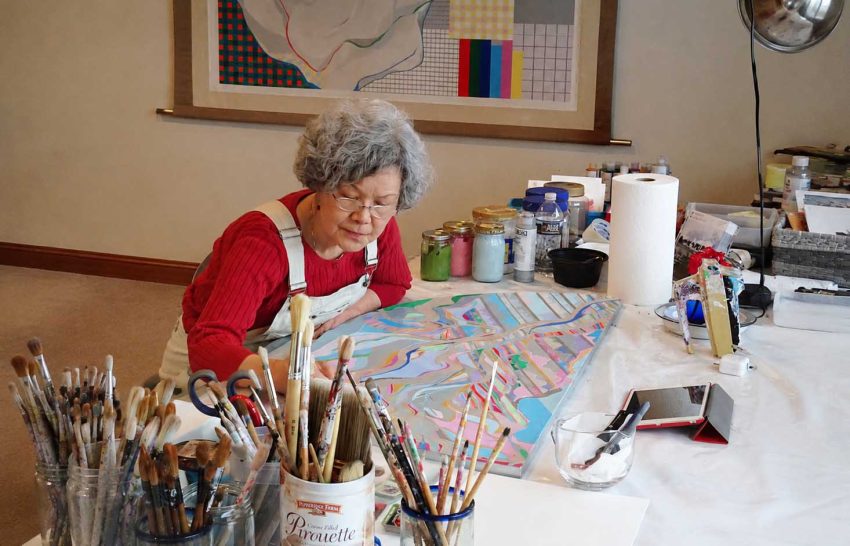
Photo courtesy of artist Ai-Wen Wu Kratz.
The Real Obstacle Isn’t Talent: It’s the Age Limit
Here’s the part of this conversation that’s often left out: many open calls, emerging-artist prizes, and residencies have explicit age limits, frequently capping eligibility somewhere between 35 and 40. An artist who picks up serious practice at 46, no matter how developed the work, is simply ineligible for a meaningful slice of the entry points that exist to introduce new artists to the field.
This is worth naming plainly, because it’s a structural fact, not a reflection of the work’s quality. Those age limits typically exist to support artists early in their working lives, financially and professionally (a legitimate goal) but they also mean that the “emerging artist” pipeline, as designed, quietly excludes a whole category of people who are emerging just as genuinely, only later.
The honest response to this isn’t to feel discouraged by it. It’s to recognize that the emerging-artist competition circuit is only one route into the art world, not the only one, and often not even the best fit for someone who is arriving with more resources and a more developed voice than the format was built around.
What Second-Career Artists Should Actually Be Looking For
Instead of chasing entry points built for 25-year-olds, a second-career artist is usually better served by opportunities designed around exactly what they bring: financial capacity, a consolidated body of work, and a clear professional history.
- General open calls without age restrictions, which judge the work on its own terms rather than the artist’s career stage.
- Representation models built for artists at any age, evaluating current work and its readiness for the market rather than a resume of prior recognition.
- International fairs and exhibitions, which tend to care considerably more about the strength and coherence of the work than about the artist’s age or origin story.
- A clear pricing structure appropriate to a first body of work being brought to market, a genuinely useful thing to get right early, regardless of the artist’s age.
Training Doesn’t Have to Mean Starting Over
One real question second-career artists face honestly is training: formal art school, informal study, or self-directed development. The good news is that this isn’t an either-or decision, and it isn’t one that needs to consume years before the practice can be taken seriously. Formal education and self-taught paths both produce working artists; what matters more is whether the artist is actually developing technically and conceptually, on whatever path gets them there fastest and most honestly.
A former architect already has an unusually strong grasp of form, structure, and spatial relationships. A former physician has spent a career looking closely and precisely at the body. A former engineer understands material behavior in a way most art school graduates have to learn from scratch. The first career isn’t a detour from developing as an artist; for many second-career artists, it was already part of the training, even if it didn’t look like one at the time.
Building Visibility Without Pretending to Be 25
A second-career artist’s public presence doesn’t need to mimic a young artist’s aesthetic or tone to be effective. In fact, it usually shouldn’t. A steady, well-documented online presence that reflects an artist’s actual voice, including the professional history that shaped it, tends to build more credibility with curators and collectors than a manufactured “emerging” narrative that doesn’t fit the artist’s real story.
The first career isn’t something to downplay or leave out of an artist bio. It’s frequently the most interesting part of it: the thing that explains why the work looks the way it does, and why the artist arrived at painting, or sculpture, or photography, with a perspective a 24-year-old simply hasn’t had time to develop.
The Reframe, One More Time
The idea that art has to start early to be taken seriously says more about how the field is structured than about what makes work good. A first career isn’t lost time before “real” art-making began. It’s frequently the foundation the art-making stands on: the discipline, the resources, the point of view, all built before the first serious piece was ever made.
Monet didn’t need to stop at 50. Neither does anyone starting seriously after it.
From First Career to Exhibited Artist
If you’ve spent decades building expertise in another field and are now bringing that same rigor to a serious studio practice, your work deserves entry points that judge it on its merits, not your age.
Explore AGI Fine Art’s current open calls, which welcome artists at any career stage, and are built to connect serious, consolidated practices with curators, collectors, and international exhibition platforms.
Get the next article and open calls
A few times a year. Unsubscribe anytime.
Questions? Feedback? Thoughts on this article, or a topic you’d like us to cover?