Formal Art Education vs. Self-Taught Practice
The question of whether an artist needs a formal degree has never been more open, or more irrelevant. In an era where YouTube tutorials, online residencies, and global peer communities sit alongside MFA programs and prestigious art schools, the old hierarchy between the academically trained and the self-taught has largely dissolved. What galleries, collectors, and curators respond to is not the credential on a CV. It’s the strength of the work, the coherence of the vision, and the artist’s ability to grow.
That said, each path has its own landscape: its own advantages, pressures, and blind spots. Understanding them helps you make smarter choices, no matter where you are in your practice.
The Case for Formal Art Education
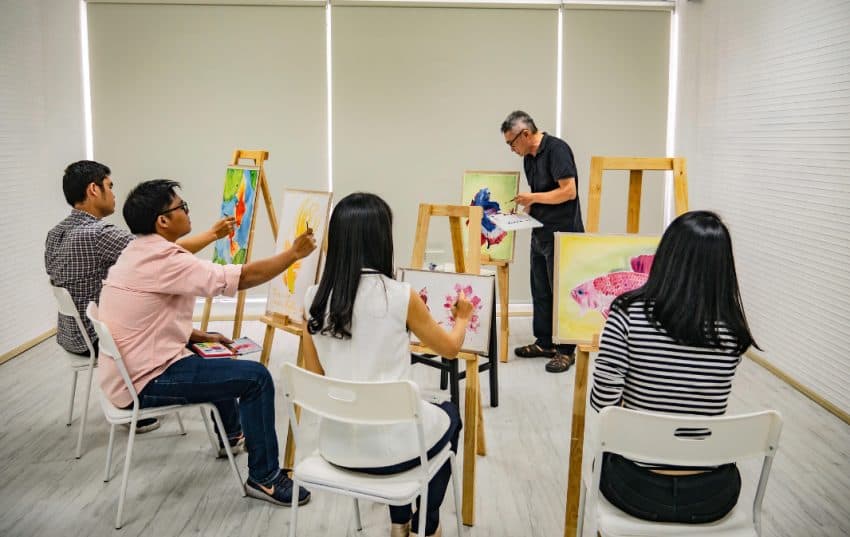
A structured art education (whether at a university, an art school, or a dedicated program) offers something that is genuinely hard to replicate on your own: time, community, and enforced experimentation.
In a school environment, you are pushed to work in media and traditions you might never have chosen independently. That friction is productive. Many artists credit their formal training not with teaching them their style, but with showing them everything they didn’t want to do, and that clarity is enormously useful.
The network matters too. Classmates become future collaborators, critics, and collectors. Faculty connections open doors to galleries and residencies. The institutional credential still carries weight in certain markets, particularly if you are interested in teaching, grants, or working within arts organizations.
Famous artists who went through formal training include Andy Warhol (Carnegie Mellon) and David Hockney (Royal College of Art). Others (Picasso, Dalí, Jasper Johns) started formal programs and left. The degree itself was never the point.
The cost, however, is real. Art school, especially in the United States, can represent a significant financial burden, and the return on investment is rarely straightforward. If you are considering this path, look beyond rankings: visit studios, speak with current students, understand the gallery relationships the program has built, and assess whether the faculty are working artists with active practices.
The Self-Taught Path: Discipline Over Structure
Self-taught artists operate without a curriculum, which means they must build their own. This is both the challenge and the strength of the path.
The most successful autodidacts are not undisciplined; they are differently disciplined. They study obsessively, but selectively, following the thread of their own curiosity rather than a syllabus. They absorb influences laterally, across disciplines, without the institutional filters that sometimes narrow the range of what is considered valid in a formal setting.
Some of the most significant artists of the twentieth century were self-taught, including Henri Rousseau and Grandma Moses, who came to their practices late in life and with no academic training. Their work was not naive; it was unburdened.
The challenge is visibility. Without the school’s built-in exhibition infrastructure, the self-taught artist must work harder to place their work in front of the right audiences. That means actively seeking out exhibition opportunities, building a professional online presence, and connecting with gallery communities outside of institutional channels.
Related: How to Promote Your Art
What Both Paths Have in Common
Regardless of how you learned to make your work, the market asks the same questions: Is the work consistent? Does it have a point of view? Is the artist professional in how they present and talk about what they do?
A strong artist profile and portfolio matter more than a degree. The ability to articulate your practice (in writing, in person, in conversation with a curator) is something neither path automatically provides. It has to be developed.
Both formally trained and self-taught artists benefit from continued engagement with the wider art world: visiting exhibitions, attending art fairs, understanding the context in which their work exists. Isolation, regardless of training, tends to narrow rather than deepen a practice.
The Third Path: Ongoing and Hybrid Learning
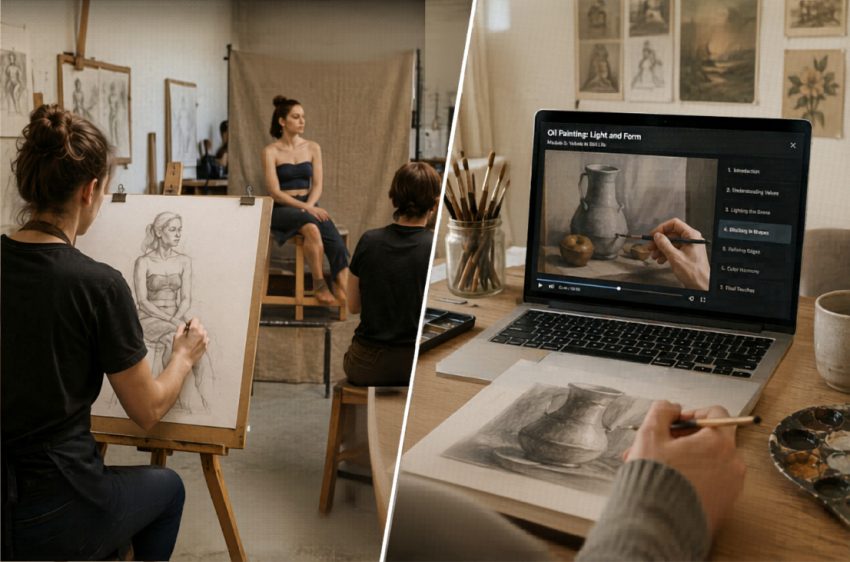
The sharpest distinction between formal and self-taught is becoming increasingly blurred. Many artists combine both: completing a foundation year, then leaving to build independently; attending targeted workshops between sustained studio periods; or using online art courses to fill specific technical gaps without committing to a full program.
This hybrid approach is now mainstream. The question is not which camp you belong to, but what you are actually learning, and whether it is making your work stronger.
What Actually Matters When Working with an Agency
At AGI Fine Art, we work with artists from both backgrounds: formally trained painters and sculptors who came through programs at major institutions, and self-taught artists who developed their practice over decades of independent work. As an artist agency, we have represented both in international art fairs and exhibitions in New York and beyond.
What we look for is not a biography. It is a body of work that demonstrates range, consistency, and a clear artistic identity. It is a professional approach to presenting and communicating that work. And it is an artist who is ready, not one who is still waiting for the right credential to feel legitimate.
The credential does not make the work. The work makes the artist.
Take the Next Step
If you are ready to bring your work to an international audience, regardless of your background, we invite you to explore our current open calls. AGI Fine Art regularly curates exhibitions and art fair presentations in New York and beyond, and we are actively looking for artists whose work is ready to be seen.
Get the next article and open calls
A few times a year. Unsubscribe anytime.
Questions? Feedback? Thoughts on this article, or a topic you’d like us to cover?