The Day Job Question: Building a Practice Without Burning Out
Almost no artist supports themselves on art sales alone, especially not early on, and often not for years after that. This is true for painters with gallery representation, sculptors with museum acquisitions, and printmakers with steady collector bases. Most of them have had, or still have, some other source of income: teaching, freelance design, a corporate job that has nothing to do with art at all.
And yet the conversation around “having a day job” is often soaked in shame, as if it’s a confession rather than a fact of how almost every working artist actually lives. This piece is an attempt to talk about it plainly, not as a compromise to apologize for, but as one legitimate structure among several for building a sustainable practice.
Where the Shame Comes From
Part of the discomfort comes from a very specific, very narrow image of what “being a real artist” looks like: someone who wakes up, walks into the studio, and makes art full-time, funded entirely by sales of that art. It’s a compelling image, and it does describe some artists’ lives: usually later in a career, and usually after a long runway of exactly the kind of dual-income period being discussed here.
Treating that image as the only legitimate version of “making it” sets up almost everyone to feel like they’re falling short of a standard that was never realistic to begin with. It also ignores how many celebrated artists throughout history worked other jobs for large parts of their careers, sometimes their whole careers, without that fact diminishing the work itself.
The shame isn’t really about the day job. It’s about a myth of purity: the idea that art made under mixed circumstances is somehow less serious than art made under ideal ones. Almost no art in history has actually been made under ideal circumstances.
A Day Job Is Infrastructure, Not an Identity
It helps to think of a day job the way you’d think of a good studio setup, reliable materials, or a functioning back, as infrastructure that supports the work, not as a statement about who you are. The job funds the materials, the studio rent, the framing, the shipping, the occasional fair application fee. It also, in many cases, funds something less visible but just as important: the ability to make work without every piece needing to sell in order to eat.
That last point is worth sitting with. Artists who depend entirely on sales for survival often feel pressure to make what sells rather than what the work actually needs to become. A day job, paradoxically, can protect the integrity of the art by removing some of that financial pressure from each individual piece. This isn’t true for everyone, and it isn’t the only way to protect that integrity, but it’s a real and underdiscussed benefit, not just a consolation prize.

The Real Design Problem: Time, Not Legitimacy
Once the shame is set aside, what’s left is a genuine, practical design problem: how do you build a consistent practice around a job that takes up most of your waking hours?
This is a scheduling and energy-management question, not a character question, and it responds to the same kind of problem-solving you’d bring to any other constraint in the studio.
A few patterns that tend to work, across very different jobs and very different mediums:
- Protect small, recurring blocks over rare large ones. Two hours every evening, four times a week, tends to produce more finished work over a year than waiting for a mythical free weekend that rarely arrives intact.
- Lower the activation energy for starting. Keep a project in a state where picking it back up takes minutes, not an hour of setup: canvases pre-stretched, a sketchbook always in reach, a digital file already open.
- Match the task to the energy you actually have. Save research, sketching, or planning for the drained hours after work, and reserve weekend mornings, when energy is highest, for the work that needs full focus.
- Let the studio space itself do some of the discipline for you. A dedicated corner, even a small one, that stays set up and ready removes one more barrier between “I have twenty minutes” and “I’m actually making something.”
None of this requires quitting the job or waiting for permission. It requires treating the available time as a real constraint to design around, the same way you’d design around a small studio or a limited materials budget.
Redefining “Serious” Practice
A practice built around a day job often looks different from a full-time studio practice, and it’s worth naming that difference honestly instead of pretending it isn’t there. Output may be slower. Series may take longer to complete. There may be stretches (a demanding season at work, a family emergency) where almost nothing gets made.
None of that makes the practice less serious. Seriousness isn’t measured in volume or speed; it’s measured in whether the work keeps developing, whether ideas keep getting followed through, and whether the artist keeps showing up to it in whatever form is available. A practice that produces twelve strong pieces a year, built entirely around evenings and weekends, is not a lesser version of a practice that produces sixty. It’s a different rhythm, suited to a different set of constraints.
This reframing matters because it changes what “falling behind” even means. Comparing your output to a full-time artist’s output, while working forty hours a week at something unrelated, is comparing two different situations as if they were the same one.
Building Income Without Abandoning the Day Job, Yet
For many artists, the goal isn’t to escape the day job overnight; it’s to gradually build enough structure around the art practice that stepping away eventually becomes possible, if and when it makes sense. That structure tends to include several small, compounding pieces rather than one dramatic leap:
- A clear, consistent pricing strategy so that whatever does sell actually reflects the value of the work, rather than being priced reactively out of eagerness to make a sale.
- A modest, sustainable presence online that documents the work consistently, even on a limited schedule, so that visibility keeps building in the background while the day job continues.
- A realistic sense of where the broader art world timeline actually sits for someone building a practice part-time: most trajectories are longer and less linear than they appear from the outside, and that’s normal rather than a sign of falling behind.
None of these require leaving the job first. They’re groundwork that can be laid slowly, in the same small, recurring blocks of time used for the work itself.
When, and Whether, to Make the Leap
At some point, many artists with a day job start asking whether it’s time to go full-time. There’s no universal answer, but a few honest questions tend to clarify it better than vague ambition does:
- Is the income from the practice covering a meaningful, growing share of actual expenses, not hypothetically, but on the last twelve months of real numbers?
- Is the day job actively limiting the work (not just taking time, but preventing specific opportunities like exhibiting internationally or committing to a demanding studio schedule) or is it mostly just tiring?
- Is there a support structure in place (savings, a partner’s income, a gallery or representation arrangement) that can absorb a slower first year or two of full-time practice?
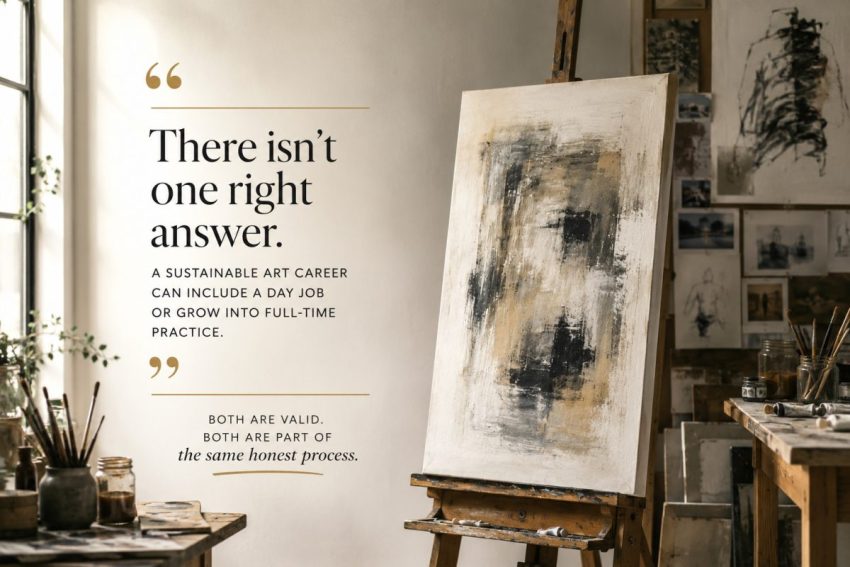
For some artists, the honest answer is that the day job isn’t a temporary phase to escape; it’s simply part of the shape their practice will always take, and that’s a legitimate, permanent structure rather than a waiting room. For others, the day job is genuinely a bridge to a full-time practice, and the numbers and readiness eventually make the leap clear. Both are valid outcomes of the same honest process.
The Reframe, One More Time
Having a day job doesn’t disqualify you from being a serious artist. It’s simply one structure, among several, for funding and protecting a practice, and it’s the structure that most artists, including many now considered among the most significant of their generation, worked within for a large part of their careers.
The work doesn’t need ideal conditions to be worth making, or worth taking seriously. It needs consistency, honest expectations, and a schedule designed around the time that’s actually available, not the time you wish you had.
From Steady Practice to Public Exhibition
However your practice is structured (full-time, part-time, or built entirely around evenings and weekends) the work still deserves a path toward being seen.
When you’re ready to put it in front of curators and collectors, explore AGI Fine Art’s current open calls. From curated exhibitions to international art fairs, these opportunities are designed to connect artists with new audiences, regardless of how their practice fits around the rest of their life.
Get the next article and open calls
A few times a year. Unsubscribe anytime.
Questions? Feedback? Thoughts on this article, or a topic you’d like us to cover?