Should You Run a Holiday Sale? What Artists Get Wrong About Seasonal Discounts

Every November, the same message starts showing up in artists' feeds: Black Friday deals, holiday markdowns, "everything 20% off this weekend only." Retailers, print shops, and even other artists seem to be doing it, and the pressure to join in can feel like a test of whether you're serious about selling.
But original art isn't a sweater. A price that changes with the calendar sends a message about what the work is worth, and that message sticks long after the season ends. Before you announce a sale, it's worth deciding, on purpose and well ahead of time, whether a discount actually serves your practice.
Why The Pressure To Discount Is So Strong
The holiday season really is a busy buying period. People are shopping for gifts, thinking about their homes, and more open to spending than at other points in the year. For an artist with unsold work and a few slow months behind them, that can feel like a narrow window to catch up.
Add to that the visual noise of everyone else's promotions, and a discount starts to feel less like a strategy and more like the default. The risk is making the decision in the moment, from anxiety or comparison, instead of from a plan.
What An Unplanned Sale Actually Costs
A discount doesn't only reduce the price of the pieces that sell. It can carry a few costs that aren't obvious in the moment:
- It resets the reference point. Once a collector has seen a piece at a lower price, the original number starts to look inflated, even if it's the price you set for good reasons.
- It undercuts earlier buyers. Someone who paid full price in spring may feel differently when the same work is marked down in December. For collectors, trust in a stable price is part of what they're buying.
- It muddies your pricing story. A clear, consistent pricing structure is one of the signals that tells a collector or gallery you're a professional. A pattern of ad hoc discounts makes that structure harder to read.
- It can create a pattern. If a sale happens every winter, regular followers learn when to wait.
None of this means a discount is always wrong. It means it has a real cost, and the cost should be weighed against what you gain.

How Discounts Train Collectors To Wait
The most lasting effect of a sale is behavioral. If your audience sees a promotion once, it reads as a special event. If they see it twice, it starts to read as a schedule. After that, interested collectors have a reason to hold off buying at any other time of year, since the best price seems to be a matter of waiting.
That puts you in a bind: the more reliably you discount in the holidays, the more you may be trading full-price sales during the rest of the year for discounted ones in November and December. It's the same logic behind why price consistency across channels matters so much. Collectors pay attention, and what they see repeatedly becomes what they expect.
Questions To Ask Before You Discount
A short, honest checklist can keep the decision from being made in a rush:
- What is the goal? Clearing inventory, reaching new buyers, and raising cash are three different problems, and a sale isn't the best answer to all of them.
- Is the work priced correctly in the first place? If pieces aren't selling at their listed price all year, the issue may be pricing, audience, or visibility, not the absence of a holiday promotion.
- Can you afford the margin? Materials, framing, shipping, and fees don't shrink when the price does.
- Who will it reach? A discount posted to an audience that doesn't know your work yet rarely turns into collectors. It often turns into one-time bargain hunters.
- Would you be comfortable if your best collector saw it? If the answer is no, that's useful information.
If You Decide To Run A Promotion, Structure It
Some artists do choose to run a seasonal offer, and it can work when it's deliberate. A few principles keep it from backfiring:
- Decide in advance, not in the moment. Set the terms, dates, and which work is included before the season starts, and stick to them.
- Keep it narrow. Limit the promotion to specific pieces, such as older work, a particular series, or prints and smaller works, rather than your entire body of work or your strongest pieces.
- Make it short and specific. A defined window with a clear end date reads as an exception, not a new normal.
- Be honest about the reason. "Clearing the studio before the new year" is a more believable context than a generic "holiday sale."
- Don't make it a habit. Treat each seasonal offer as a decision, not a tradition.
- Document every sale. Even discounted sales deserve a simple written record listing the piece, the price paid, and the terms.
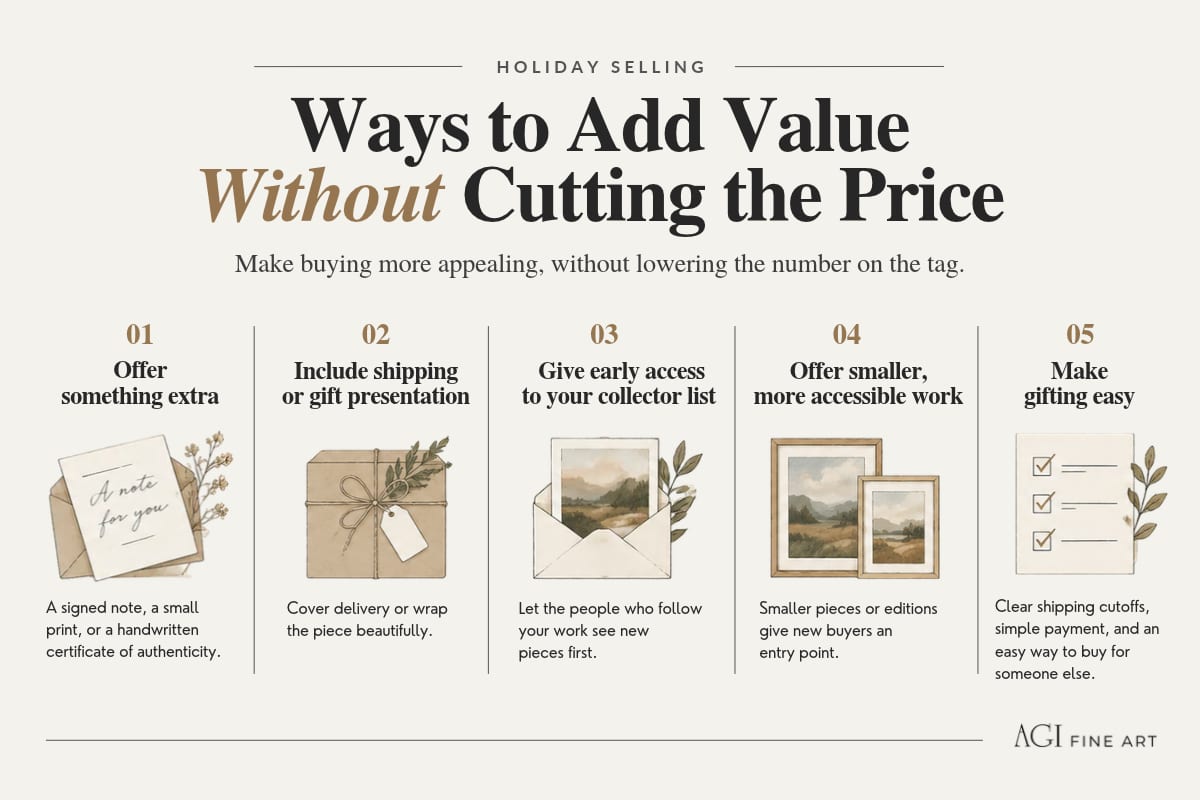
Ways To Add Value Without Cutting The Price
If the goal is to make buying feel more appealing during the holidays, there are several ways to do it that don't lower the number on the tag:
- Offer something extra. A signed note, a small print, or a handwritten certificate of authenticity gives a gift buyer something tangible to give along with the work.
- Include shipping or gift presentation. Covering delivery or wrapping a piece beautifully can be more persuasive than a percentage off, and it costs you less than a markdown.
- Give early access to your collector list. Letting people who already follow your work see new pieces first rewards loyalty, and it's much of the point of building a collector list in the first place.
- Offer smaller, more accessible work. A limited run of smaller pieces or editions at a considered price point gives new buyers an entry point without discounting your main work.
- Make gifting easy. Clear shipping cutoffs, simple payment options, and a straightforward way to buy for someone else remove friction at the moment it matters most.
Handling Discount Requests From Individual Collectors
Even if you don't run a sale, someone will probably ask for a better price in a message or conversation. This is where a policy helps, because a one-off exception made on the spot is how pricing drifts without anyone intending it.
Decide ahead of time whether you offer any discounts at all, and for whom. Some artists reserve them for repeat collectors, multi-piece purchases, or institutional buyers, and say so plainly. When the answer is no, a warm, firm response protects both the sale and the relationship. The same approach covers price negotiations that arrive through DMs, where having your language ready means you aren't improvising under pressure.
Don't Forget The Collectors Who Already Paid Full Price
One audience is easy to overlook when planning a promotion: the people who've already bought. If you do discount, consider how existing collectors will feel, and whether a heads-up or a small thank-you could keep their trust intact. A collector who feels their purchase was devalued is much less likely to buy again or recommend your work, and those quiet referrals are often worth more than a seasonal bump.
Planning The Season Instead Of Reacting To It
Review your inventory, decide what you want to sell, set your policy on discounts, prepare your gift-friendly offerings, and plan your communication. That gives you a calm, consistent season instead of a scramble.
It also keeps your public presence steady. A consistent, professional online presence throughout the year is what builds the audience that buys in the holidays in the first place, and it works better than a burst of promotion in the last two months of the year.

From A Considered Season To A Confident Practice
Pricing decisions made with intention, in the holidays and the rest of the year, are part of the professional foundation that helps collectors buy with confidence.
Explore AGI Fine Art's current open calls and put work you're proud to price properly in front of curators and collectors.
Get the next article and open calls
A few times a year. Unsubscribe anytime.
Questions? Feedback? Thoughts on this article, or a topic you’d like us to cover?