Do You Need a Contract for That Sale?

A collector loves a piece at a studio visit, hands over cash or a bank transfer, and walks out with the work under one arm. No paperwork changes hands. Weeks later, a similar exchange happens over Instagram DMs: a price agreed in a thread, a payment sent, a shipping label printed, and no record beyond a scrollable conversation that could vanish with a deleted account or a lost phone.
Most artists sell this way for years without incident, which is exactly why the habit rarely gets questioned. But "usually fine" isn't the same as "actually protected," and the moment something goes wrong (a payment dispute, a damaged shipment, a disagreement about what was actually promised), the absence of any written record turns a minor issue into a real problem for everyone involved.
Why This Gets Skipped So Often
Contracts sound like something reserved for galleries, lawyers, and large transactions, not for a $400 painting sold directly out of the studio. There's also a real, understandable discomfort with introducing paperwork into what's supposed to be a warm, personal exchange: a collector connecting with the work, and with the artist behind it. Pulling out a formal document in that moment can feel like it cheapens the relationship rather than protecting it.
That discomfort is legitimate, but it rests on a false choice. A simple, clear record of a sale doesn't have to look or feel like a corporate contract, and it doesn't have to interrupt the warmth of the exchange. It just has to exist.
What "A Contract" Actually Means Here
For the vast majority of direct sales, a full legal contract with clauses and signatures isn't what's needed, and expecting artists to produce one for every sale is part of why the habit never sticks. What actually matters is a simple, dated, written record that both sides can point back to later. In practice, this usually takes one of two forms:
- An invoice or bill of sale, given at the time of purchase, listing the piece, the price, and the terms of the sale.
- A short written confirmation, even an email or a formal message summarizing a DM conversation, that both parties can refer back to if a question comes up later.
Neither requires legal language, a lawyer, or a fee. Both take a few minutes to produce, and both do the one thing an informal handshake or a DM thread can't reliably do: create a record that survives the moment of the sale itself.

What A Minimal Sale Record Should Include
A simple, effective record doesn't need to be complicated. At minimum, it should cover:
- The work itself: title, medium, dimensions, and year, so there's no ambiguity about exactly what was sold.
- The price and payment terms: the agreed amount, currency, and whether it was paid in full or in installments.
- The date of sale.
- Buyer and seller names, and contact information for both.
- Shipping and handling terms, if the piece is being shipped: who's responsible for cost, insurance, and any damage in transit.
- Copyright and reproduction rights: a simple line confirming that the artist retains copyright unless explicitly stated otherwise, which is often assumed but rarely written down.
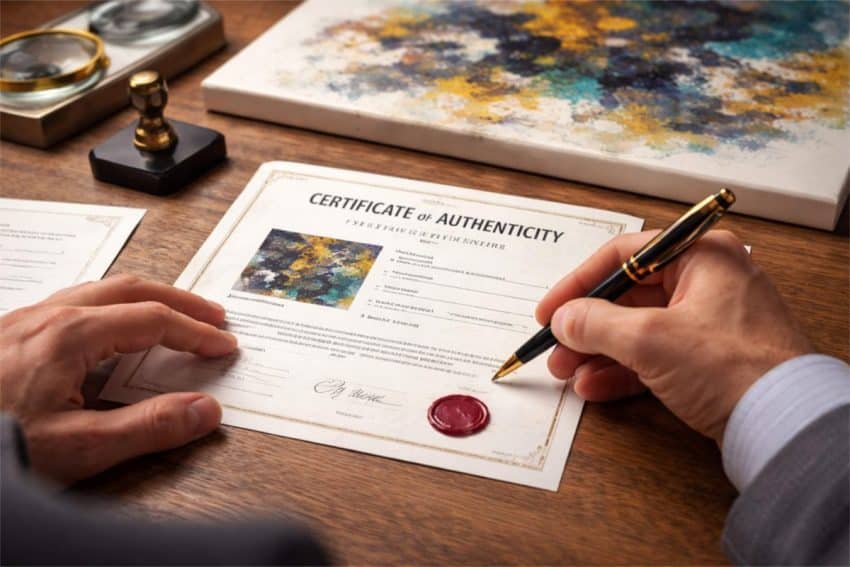
- Authenticity confirmation: a brief statement that the work is an original, signed by the artist, which becomes genuinely useful documentation if the piece is ever resold or appraised.
That's it. None of this requires specialized legal knowledge, and a template built once can be reused for every future sale with only the specific details changed.
When This Matters Most
Some sales carry more risk than others, and it's worth being more deliberate about documentation precisely in those cases:
- Higher-value pieces, where a dispute would carry real financial weight for either party.
- International sales, where shipping, customs, and currency add several more points where a misunderstanding can occur. This is a growing concern as more artists sell across borders.
- Payment plans or installment sales, where a written schedule protects the artist if payments stop partway through.
- Commissions, where expectations about size, subject, timeline, and revisions genuinely need to be agreed upon in advance, not assumed.
- Sales through intermediaries, such as a friend brokering an introduction, a pop-up event organizer, or anyone standing between the artist and the direct buyer, where it's especially useful to have the terms in writing rather than relayed secondhand.
A five-dollar studio sketch probably doesn't need much more than a receipt. A four-figure commission, paid over three installments and shipped internationally, deserves the fuller version.
How To Keep It From Feeling Cold
The concern that paperwork will make a sale feel transactional is worth taking seriously, because it's often true of poorly handled paperwork: a rigid form, handed over in silence, can genuinely deflate a warm moment. The fix isn't skipping the documentation; it's handling it the same way the rest of the interaction was handled: personally.
A simple line works well here: "I'll send over a quick confirmation for your records. It just covers the piece, the price, and shipping if we need it." Framed this way, the paperwork reads as professionalism, not suspicion. Most collectors, especially ones who've bought art before, expect this and appreciate it; a lack of any documentation is often more likely to raise questions than a straightforward one does.
This kind of clarity also reinforces the same consistent, considered pricing a serious practice depends on. A written record makes it much easier to keep prices consistent across studio visits, fairs, and online sales, because there's an actual log to check back against instead of memory alone.
DMs Count As Sales Too
A sale negotiated over Instagram or another platform's messages is just as real as one made in person, and it deserves the same minimal documentation, arguably more, since the conversation itself lives inside a platform the artist doesn't control. A social media exchange that ends in a sale should be followed by a short confirmation sent outside the platform (an email or a simple document) so the record doesn't depend on an app staying accessible indefinitely.
When To Bring In Real Legal Support
Most direct sales don't need a lawyer. A few situations genuinely do: a significant commission with complex terms, a dispute that's already escalated, or a sale involving licensing or reproduction rights beyond a simple original purchase. In those cases, brief, one-time legal advice is worth the cost, and it's exactly the kind of professional infrastructure that a structured representation relationship is often built to help artists navigate, rather than figuring it out alone under pressure.
The Reframe, One More Time
A contract, in the context most artists actually need, isn't a wall between the artist and the collector. It's a small, quiet piece of professionalism that protects both sides of a relationship worth protecting, and it takes a few minutes to create, not a law degree to understand.

From Documented Sales To A Documented Practice
Clear, consistent documentation of every sale is part of the same professional foundation that makes a practice ready for bigger opportunities.
Explore AGI Fine Art's current open calls and bring that same clarity to how your work reaches curators and collectors.
Get the next article and open calls
A few times a year. Unsubscribe anytime.
Questions? Feedback? Thoughts on this article, or a topic you’d like us to cover?