Self-Promotion for Artists Who Hate Self-Promotion
Most artists didn’t get into this to become marketers. You wanted to make things, not post about making things, not write captions, not “build a brand.” And yet here you are, staring at a blinking cursor, trying to figure out how to tell people your work exists without sounding like a used-car salesman.
Here’s the good news: you’re not bad at self-promotion. You just hate the version of it you’ve been sold.
This isn’t another article telling you to post more, be more consistent, or “show up every day” until you burn out. It’s a different way of thinking about visibility: one built for people who’d rather spend their energy in the studio than in front of a ring light.
The Problem Isn’t You, It’s the Framing
Somewhere along the way, “promotion” got tangled up with “pitch.” We picture the hustle-bro energy of funnels, calls-to-action, and forced urgency (engagement hacks, growth strategies, algorithms to outsmart) and it feels completely at odds with why we make art in the first place. So we freeze, or we avoid it entirely, and then feel guilty for not “doing more” for our careers.
That guilt is doing a lot of damage. It convinces artists that if they’re not comfortable self-promoting, something is wrong with them: that they’re missing a business gene other, more successful artists have. But watch how the artists you admire actually talk about their work online, and you’ll usually notice something: they’re not selling. They’re narrating. They’re letting people in.
Promotion doesn’t have to mean selling. It can just mean sharing. And sharing is something artists are actually good at; it’s the instinct that made you want to make the thing in the first place. You wanted someone to see it. That impulse hasn’t gone anywhere; it’s just been buried under the anxiety of “doing marketing right.”
The shift is small but it changes everything: instead of asking “how do I convince people to care about my work,” ask “how do I let the people who’d already care about my work find it.” Those are two completely different jobs. The first one is exhausting and feels false. The second one is just visibility with the pressure removed.
Why This Matters, Even If You Hate It
It would be easier to just say “skip promotion entirely and let the work speak for itself.” But the truth is that visibility compounds. Collectors, curators, and galleries increasingly discover artists online before they ever meet them in a room. A body of work with no public trace is invisible not because it isn’t good, but because nobody knows to go looking for it.
The goal isn’t to become a full-time content creator. It’s to make sure that when someone is looking (a curator scouting for a show, a collector who saw one piece and wants to see more, a gallery doing due diligence before a studio visit) there’s something there. A trail. Evidence that you exist, that you’re working, that you take your practice seriously enough to document it.
That’s a much lower bar than “build a personal brand.” It’s closer to leaving a light on.
Show the Process, Not Just the Product
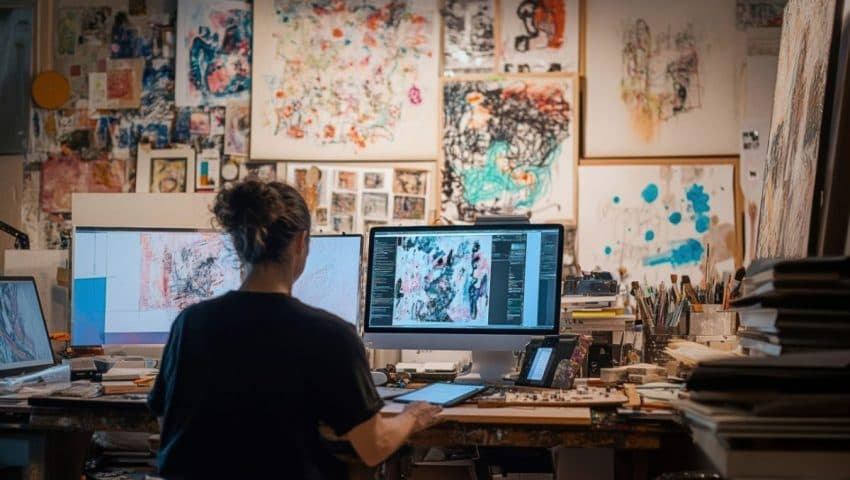
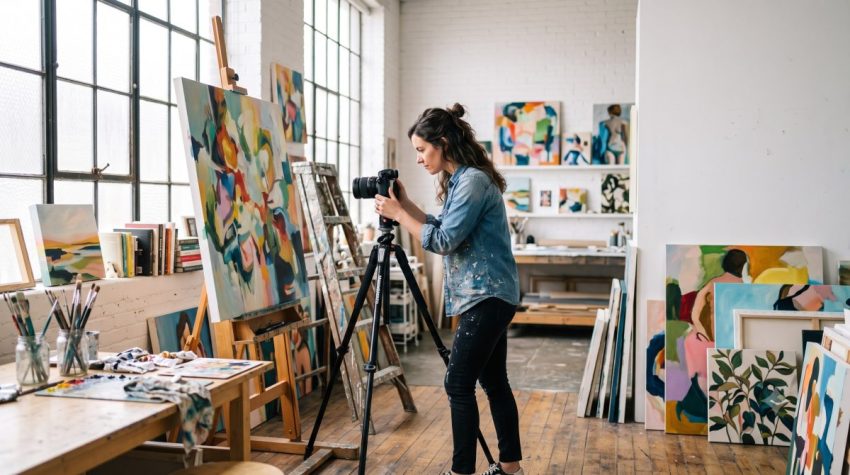
One of the easiest, lowest-pressure ways to be visible online is to start treating your feed as a window into your studio.
- A photo of your messy desk mid-project
- A short clip of a brush stroke, a chisel pass, a line of code compiling
- A “before and after” of a piece that changed direction halfway through
- The specific problem you were trying to solve today and how you solved it
- A pile of failed attempts before the one that worked
- The materials or reference images pinned above your desk
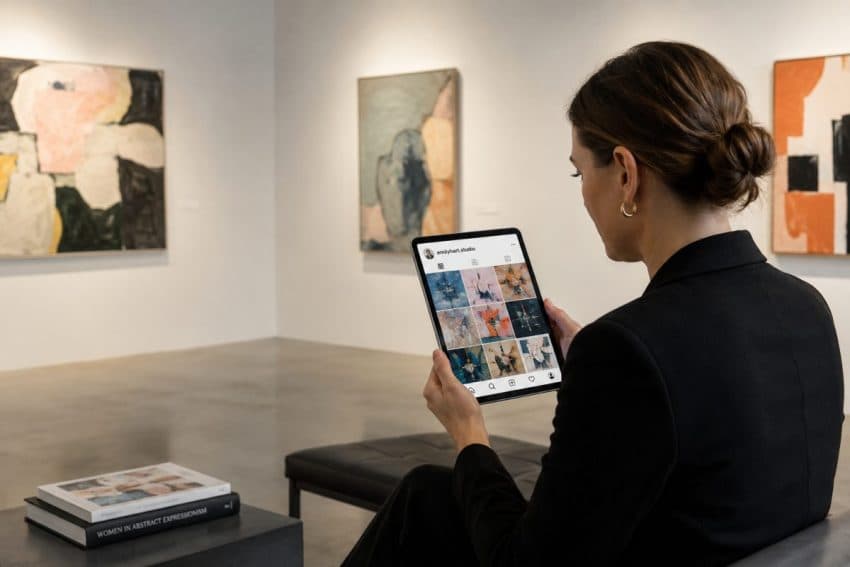
None of this requires you to say “buy my art” or “check out my new piece!!” It just requires you to document what you’re already doing. People are far more drawn to process than to polish; it’s the difference between a storefront and an open studio door. A finished piece asks for admiration. A process shot invites curiosity, and curiosity is a much easier feeling to act on than admiration is.
This also solves a practical problem: process content is easy to produce because it doesn’t require you to finish anything first. You don’t need a “big reveal” to have something worth sharing. You just need to be honest about where you are right now.
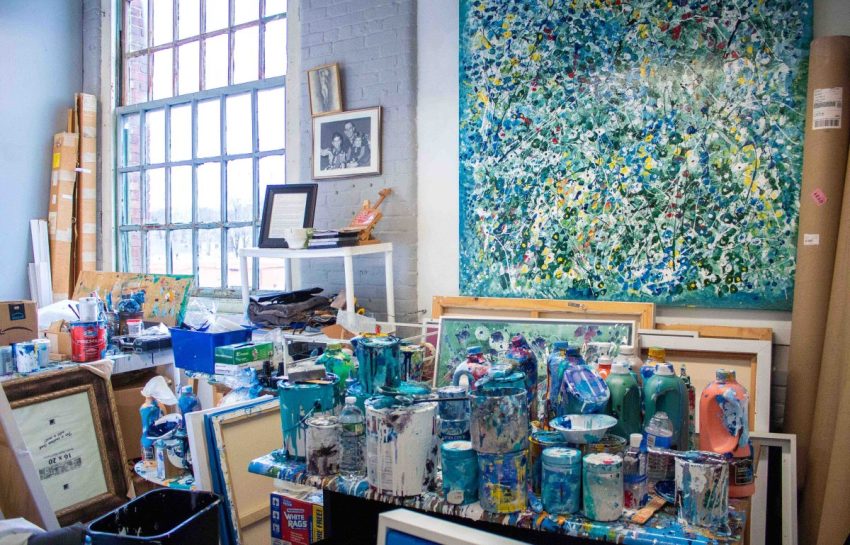
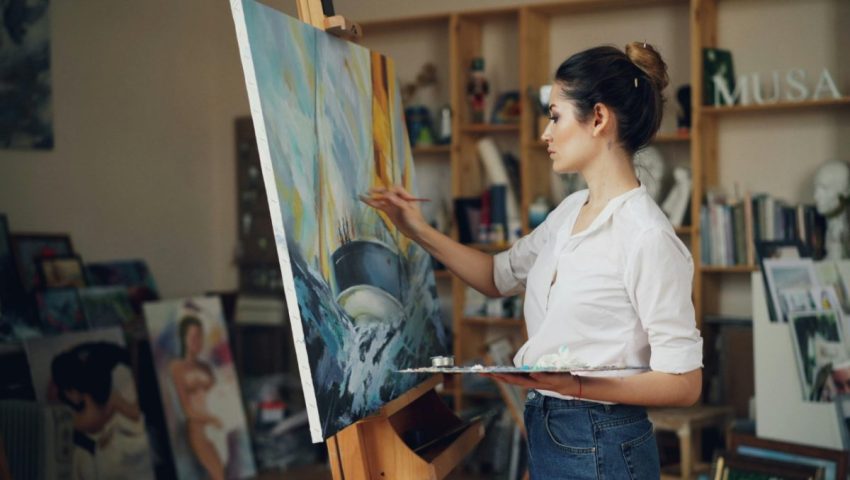
Photo featuring the studio and artwork of abstract painter Mark Schiff.
Talk About Your Work the Way You’d Talk to a Friend
A lot of self-promotion anxiety comes from writing captions as if you’re addressing a stadium. Try writing as if you’re texting one specific person who already likes your work: a friend, a past client, a fellow artist you admire.
That one shift in the imagined audience tends to strip out the corporate voice and the forced enthusiasm. You end up with something like:
“Spent way too long trying to get this shade of blue right. Finally got it around 2am. Here’s the messy in-between version next to the final.”
That’s not a pitch. That’s a person sharing something they care about. It also happens to be exactly the kind of post that makes people want to follow along, because it sounds like a person, not a press release.
If you’re not sure what to say, try finishing one of these sentences instead of starting from a blank page:
- “The hardest part of this piece was…”
- “I almost scrapped this because…”
- “I keep coming back to this idea of…”
- “Something I noticed while making this…”
None of these require confidence, salesmanship, or a call to action. They just require you to be a little bit honest about your own process, which, for most artists, is actually the easy part.
Let Other People Do Some of the Talking
Self-promotion doesn’t have to be a monologue. Some of the lowest-pressure, highest-impact moves are ones where you’re not even the one talking:
- Ask a collector or client if you can share their reaction to a piece
- Tag a gallery, publication, or collaborator when they feature you, rather than only posting it yourself
- Show up in other people’s comment sections with genuine thoughts, not just “check out my page”
- Say yes to studio visits, interviews, or panels: being asked about your work feels completely different from announcing it
- Ask a fellow artist to trade studio visits, then post about each other’s work
Word of mouth is still promotion. You’re just facilitating it instead of performing it. And there’s a credibility bonus here too: when someone else says your work is worth paying attention to, it lands differently than when you say it about yourself. Borrow that credibility whenever it’s offered to you.
In Person, Think “Invite,” Not “Announce”
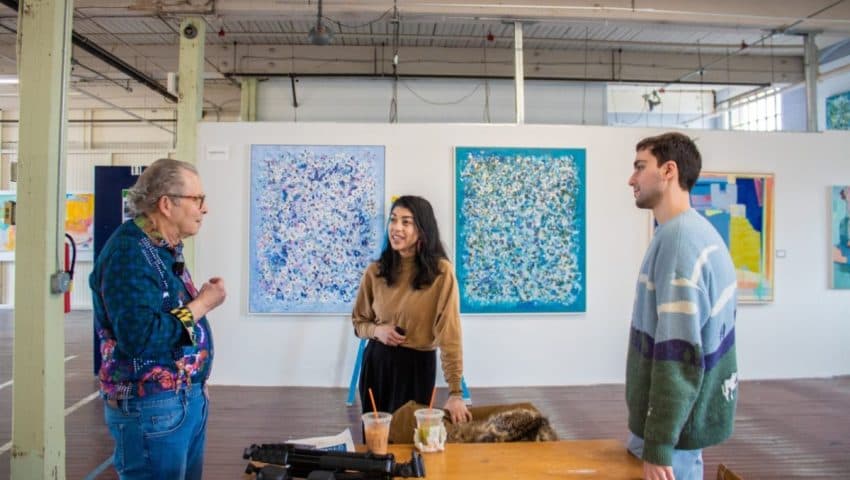
The same discomfort shows up offline. Standing at an opening trying to work the room like a networking event feels awful for most artists, and it usually reads as awkward too, both for you and for the person you’re talking to.
Instead, treat in-person visibility as an invitation rather than an announcement:
- Instead of “let me tell you about my work,” try “come see what I’m working on”
- Host a small open studio
- Bring a physical object (a small print, a zine, a sketch) that gives people something to hold and ask about, so the conversation starts itself
- Follow up with people you meet by sharing something specific and relevant, not a generic “great to meet you, check out my Instagram“
- Offer to help someone else first (introduce two people, share a resource, recommend a material or a studio) before ever mentioning your own work
The goal isn’t to convince a room full of strangers. It’s to make it easy for the few people who are already curious to lean in. Most rooms have two or three people in them who are genuinely interested in what you do. Your job isn’t to work the whole room; it’s to find those two or three people and have a real conversation.
Build a Few Reliable “Landing Spots”
Visibility only works if there’s somewhere for it to lead. Before you focus too much on what to post, make sure you have at least one place where someone curious about your work can go and get the full picture:
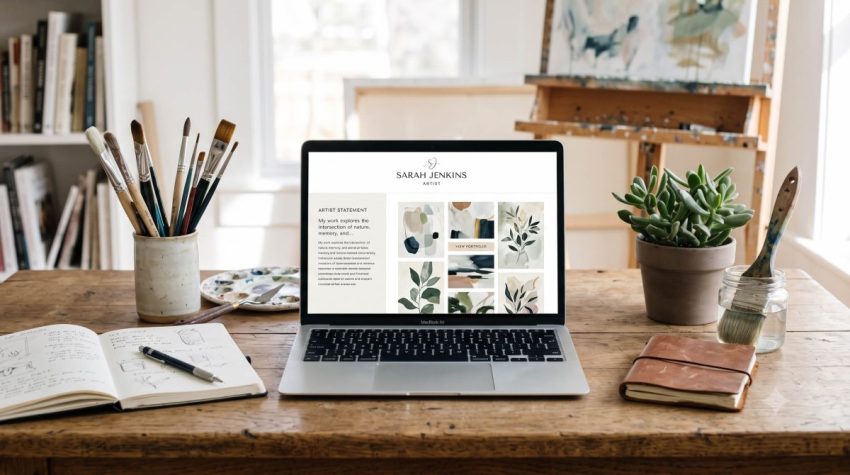
- A simple website or portfolio with current work, a bio, and a way to contact you
- One social platform kept reasonably current, rather than three kept half-abandoned
- An artist statement that sounds like you, not like a grant application
- A mailing list, even a small one, so interested people can stay in touch without depending on an algorithm
You don’t need all of these polished at once. But having even one reliable landing spot means that every small, low-pressure share (a process photo, a comment, a studio visit) has somewhere to send people who want to see more.
Consistency Beats Intensity
You don’t need a grand launch strategy or a viral moment. You need a rhythm you can actually sustain without dreading it: one process photo a week, one honest caption, one studio visit a season.
Self-promotion that feels sustainable almost always looks less like a campaign and more like a habit: small, regular, low-stakes moments of sharing what you’re already doing. Over time, that adds up to something that feels less like marketing and more like simply being seen, which, it turns out, was the actual goal all along.
It helps to think in terms of the smallest sustainable unit. If posting once a week feels like too much, post once a month. If a caption feels like too much, a single photo with no text is enough. The point isn’t volume. The point is that showing up occasionally, honestly, beats showing up intensely for two weeks and then disappearing for six months, which is the pattern most artists actually fall into, and the one that does the most damage to how visible they end up being.
The Reframe, One More Time
You don’t have to become a different person to be visible. You just have to let people watch you be the person you already are: making things, thinking out loud, showing up. That’s not selling. That’s just sharing out loud what used to happen quietly.
And the artists who do this consistently, even imperfectly, tend to build audiences that feel less like customers and more like people who are genuinely glad to be along for the ride. That’s the version of self-promotion worth doing, not because it grows a following faster, but because it’s the only version most artists can actually sustain.
From Visibility to Exhibition
Sharing your process online builds an audience, but an audience isn’t the same as a career. At some point, that visibility needs somewhere to land.
If you’ve been showing up consistently, building a body of work and a following around it, and you’re ready to take the next professional step, we invite you to explore AGI Fine Art’s current open calls. From curated exhibitions to international art fairs, these opportunities are designed to connect artists with new audiences, collectors, and professional platforms.
Get the next article and open calls
A few times a year. Unsubscribe anytime.
Questions? Feedback? Thoughts on this article, or a topic you’d like us to cover?