Rejection Is Data, Not Verdict

Every artist who submits work collects rejections. It doesn’t matter how strong the portfolio is, how many years of practice sit behind it, or how well-reviewed the last show was: the “no” pile grows faster than the “yes” pile for almost everyone, at almost every stage of a career. The question that actually determines how a career unfolds isn’t whether you get rejected. It’s what you do with the rejection once it lands.
Most artists treat a rejection as a verdict: a final judgment on whether the work, or they, are good enough. That framing is understandable, and it’s also the single biggest reason talented artists stop submitting. This article is about a different framing, one that keeps you in the game: rejection as data, not as a verdict, because the case for building an artistic career has never depended on a clean record of acceptances.
Why the Verdict Framing Is So Tempting, and So Wrong
When a gallery, fair, or open call sends back a “no,” it’s tempting to read it as a complete statement about your work’s worth. That reading feels almost inevitable, because the rejection usually arrives with no explanation at all, just a form email, or silence. In that vacuum, it’s easy for the mind to fill in the worst possible reason: the work isn’t good enough.
But a rejection from a single juror, curator, or committee is never a verdict on the work itself. It’s a data point about a very specific, very narrow moment: this particular decision-maker, looking at this particular submission, in the context of this particular program, on this particular day. Change any one of those variables and the outcome can flip entirely.
Curators are filling a specific show with a specific theme, a specific number of slots, and a specific vision they’re trying to execute, one that has almost nothing to do with whether your work is good, and everything to do with whether it fits what they’re building right now. A juried show might reject a piece that a different juried show, three months later, awards a prize. Both reactions can be “correct” for the person making them, because they’re responding to different questions.
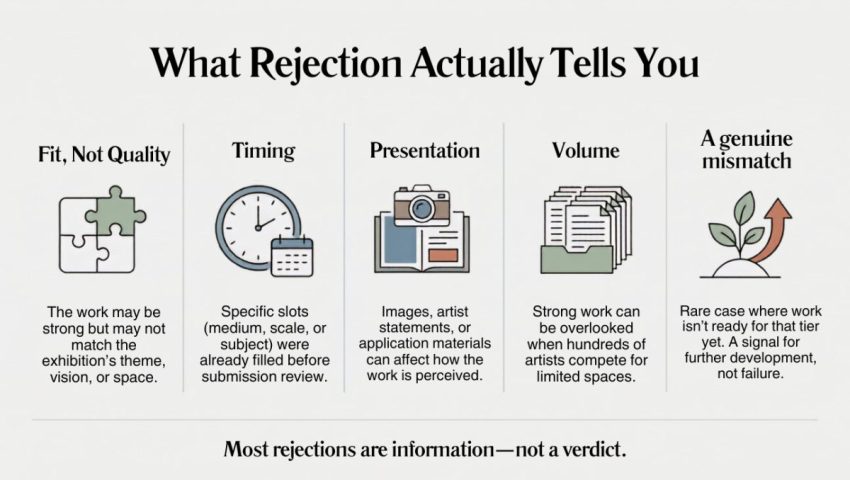
What Rejection Actually Tells You
If a rejection isn’t a verdict, what is it? Usually, it’s one of a few things, and figuring out which one applies is where the useful work happens.
- Fit, not quality. The work may be excellent and still not fit the specific curatorial vision, theme, or space constraints of that particular opportunity.
- Timing. The committee may have already filled a slot for work in your medium, scale, or subject matter before your submission was reviewed.
- Presentation. Sometimes the issue isn’t the work at all; it’s how the submission was framed: unclear images, a thin artist statement, or a proposal that didn’t answer the specific questions the application asked.
- Volume. Many open calls receive hundreds of submissions for a handful of spots. A strong piece can lose out simply because the math didn’t favor it that round.
- A genuine mismatch. Occasionally, the feedback is real: the work isn’t ready for that particular tier of opportunity yet, or it needs more development. This is the one case worth sitting with, not to spiral, but to actually look at the work with fresh eyes.
Most rejections are a mix of the first four. The fifth is rare, and even when it applies, it’s still information you can act on rather than a life sentence.
Build a Rejection Log, Not a Rejection Wound
The difference between an artist who keeps submitting and one who quits after a few hard no’s often comes down to a very simple habit: keeping a record.
A rejection log doesn’t need to be elaborate. For every submission, track:
- Where you submitted and when
- What you submitted (which pieces, which statement, which images)
- Any feedback received, even a single line
- Your own honest read on why it might not have landed
After ten or twenty entries, patterns start to surface that a single rejection can never show you. Maybe your statement keeps getting flagged as unclear. Maybe the pieces that get accepted are always from one body of work and never another. Maybe the rejections cluster around opportunities with a very specific theme your work doesn’t currently speak to, which isn’t a flaw, just a mismatch worth noting for next time.
A log turns a pile of “no’s” into a dataset. And a dataset is something you can learn from, adjust based on, and eventually use to submit smarter, instead of just submitting sadder.
Ask a Specific Question, Not “Was It Good Enough?”
When feedback is available, the instinct is to ask the vague, unanswerable question: was it good enough? That question has no useful answer, because “good enough” isn’t a fixed bar; it shifts with every jury, every theme, every year.
Replace it with sharper, more answerable questions:
- Did this piece fit the stated theme of the call?
- Was my documentation (photos, video, installation shots) clear and professional?
- Did my artist statement actually explain what this specific opportunity was asking for, or did I reuse a generic version?
- Am I submitting work that represents where I am now, or an older series that no longer reflects my strongest output?
- Is this the right category of opportunity for where my career is right now, including whether it’s time to think about going international with the work, or am I aiming too far above or below my current stage?
These questions are answerable, and answering them honestly gives you something to actually change before the next submission, rather than just something to feel bad about.

Separate the Submission From the Self
One of the quiet reasons rejection stings so much is that many artists submit work that feels inseparable from their identity. When the work is rejected, it can feel like you were rejected.
It helps to draw a small, deliberate line between the two. The work is something you made: a specific object, at a specific stage of a specific practice. It is not a referendum on your talent, your years of training, or your right to call yourself an artist. Even artists whose work now sells for enormous sums, and hangs in major institutions, collected long stacks of rejections on the way there: juried shows that passed on them, galleries that said no, fairs that never replied.
The line matters because it changes what a rejection can take from you. It can take a slot in a specific show. It cannot take your ability to make the next piece, submit to the next call, or grow into the artist you’re becoming.
Let Rejection Sharpen Your Submissions, Not Shrink Your Ambition
There’s a version of “resilience” that just means gritting your teeth and submitting to the same kind of opportunity over and over, unchanged, hoping the outcome flips through sheer persistence. That’s not resilience; it’s just repetition, and it rarely works.

Real resilience uses each rejection as an adjustment point:
- If your log shows a pattern of rejection from a certain tier of gallery or fair, it might mean it’s time to build more of a track record first (smaller shows, group exhibitions, and a stronger public presence) before aiming there again.
- If feedback repeatedly mentions unclear documentation, that’s a fixable, mechanical problem, not a comment on the work itself.
- If a body of work keeps getting passed over for thematic mismatches, it might simply mean you’re submitting it to the wrong calls, not that the work itself is weak.
None of this requires abandoning ambition. It just means directing that ambition with better information, instead of throwing the same submission at the same wall and hoping for a different result. For some artists, that also means eventually looking into structured, service-based representation that offers support beyond a single exhibition.
Keep a “Yes” File Next to the Rejection Log
It’s easy to let rejections pile up in memory while acceptances fade quickly into the background, a strange asymmetry, given that both are equally real evidence about the work. Counter this deliberately by keeping a running file of everything that went right: accepted submissions, positive feedback, sales, studio visit requests, kind words from a curator, even a single enthusiastic comment on a process post.
This isn’t about ego. It’s about accuracy. A mind that only remembers the rejections is working from a distorted dataset, and distorted data leads to distorted decisions, like quitting a path that was actually working, just because the losses were louder than the wins.
The Reframe, One More Time
A rejection is not a verdict on your work or your worth as an artist. It’s a single data point, generated by a specific person, in a specific context, on a specific day, and like any single data point, it means very little on its own. What matters is the pattern across many of them, and what you choose to do with that pattern.
Keep submitting. Keep logging. Keep asking sharper questions instead of vaguer ones. The artists who build lasting careers aren’t the ones who never hear “no”; they’re the ones who treat every “no” as information, adjust accordingly, and submit again.
From Submissions to Exhibition
If you’ve been refining your work, your documentation, and your submissions, and you’re ready to put that groundwork to the test, we invite you to explore AGI Fine Art’s current open calls. From curated exhibitions to international art fairs, these opportunities are designed to connect artists with new audiences, collectors, and professional platforms.
Get the next article and open calls
A few times a year. Unsubscribe anytime.
Questions? Feedback? Thoughts on this article, or a topic you’d like us to cover?