When to Say No to an Exhibition Opportunity

Our piece on rejection looked at what happens when a gallery, fair, or open call says no to you. This is the other side of that conversation: what happens when the opportunity says yes, and it’s you who has to decide whether to say yes back.
That decision gets far less attention than it deserves. Most advice aimed at artists assumes every opportunity is worth taking if it’s offered: that the scarcity of exhibition slots makes turning one down almost unthinkable. But not every yes serves the work, or the career, equally. Learning to say no, deliberately and occasionally, is as much a professional skill as learning to keep submitting after a no.

Why Every Yes Feels Mandatory
Opportunities can feel rare enough that turning one down seems like a risk the practice can’t afford. That fear has a name worth naming honestly: FOMO, the anxiety that this specific chance might be the only one, and that declining it means losing ground that won’t come back.
FOMO makes for a bad filter, because it evaluates every opportunity against the same imagined scarcity, rather than against what the opportunity actually offers. Under that pressure, a mismatched exhibition and a genuinely valuable one can end up looking identical, both simply “a chance,” both feeling too risky to refuse.
The Real Cost Of Saying Yes To Everything
Saying yes to every offered opportunity isn’t a neutral, safe default. It carries real costs, even when nothing goes visibly wrong:
- Diluted focus. Preparing for a mismatched show pulls time and materials away from the work that actually belongs in front of the right audience, including, sometimes, the studio time and space that a stronger opportunity would have deserved instead.
- Financial strain. Entry fees, shipping, framing, and travel add up quickly, and a poorly attended or poorly matched show can mean spending more than the exposure or sales it generates ever justify.
- Diminished perceived value. A body of work shown everywhere, regardless of fit, starts to look less curated and more indiscriminate.
- Wasted goodwill. Committing to an opportunity that isn’t actually a priority, then delivering rushed or under-resourced work for it, tends to cost more relationship capital with organizers than a respectful decline ever would.
None of this means opportunities should be treated with suspicion. It means they deserve real evaluation, not automatic acceptance.

A Few Honest Questions Before Saying Yes
A short, consistent set of questions, asked before accepting rather than after committing, does most of the filtering work:
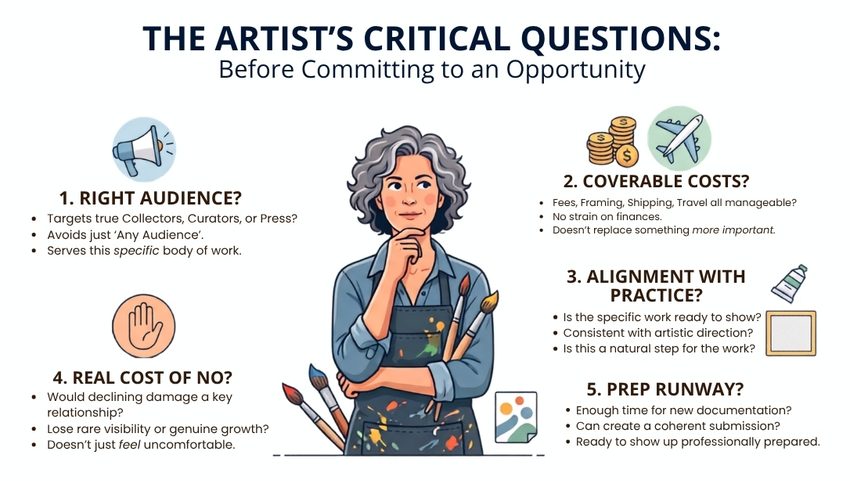
- Does this reach the right audience for this specific body of work (the collectors, curators, or press actually likely to respond to it) or does it just reach an audience?
- Can the costs (entry fees, framing, shipping, travel, time away from the studio) be covered without strain, or would this show come at the expense of something more important?
- Does the venue, theme, or context align with where the work and the practice are actually headed, or does it pull in a direction that doesn’t serve the current body of work?
- Would declining actually cost something real (a relationship, a rare kind of visibility, a genuine next step) or does it just feel like it would, because saying no is uncomfortable?
- Is there enough runway to prepare properly (new documentation, a coherent submission, a public presence that reflects the work well) or would accepting mean showing up underprepared?
If most of these come back genuinely positive, it’s likely a real opportunity. If several come back shaky, that’s useful information, not a reason to panic, but a reason to slow down before committing.
Signs It’s Actually A Fit
Beyond the questions above, a few concrete signals tend to separate a genuinely valuable opportunity from one accepted out of fear of missing out:
- The venue or fair has previously shown work comparable in medium, scale, or subject to yours: evidence the audience there is actually the right one.
- The organizers can speak specifically about why they’re interested in this particular body of work, rather than issuing a generic invitation.
- The logistics (dates, costs, shipping, insurance) are clear and manageable well in advance, not vague or rushed.
- Accepting doesn’t require abandoning or rushing another commitment that already matters more to the practice’s current direction.
Signs It’s FOMO, Not Fit
The opposite pattern is worth naming just as clearly, because it’s easy to rationalize in the moment:
- The main reason for saying yes is “opportunities like this don’t come along often,” rather than any specific alignment with the work.
- The venue or context has little to do with the current direction of the practice, but the invitation itself feels flattering enough to override that mismatch.
- The costs are genuinely uncertain or higher than comfortable, but the fear of regret is louder than the financial concern.
- There’s a nagging sense of “I should feel more excited about this than I do,” which is often a quieter, more reliable signal than it gets credit for.
How To Decline Without Burning A Bridge
Turning down an opportunity doesn’t have to damage the relationship behind it; in fact, a clear, respectful decline often preserves the relationship better than a reluctant yes that leads to an underwhelming show. A short, genuine note explaining the decision, ideally with an offer to stay in touch for future opportunities, tends to be remembered far more favorably than either silence or a commitment that clearly wasn’t a priority once delivered.
This is also where a more structured, service-based relationship with a gallery or representative can help: having a trusted second opinion on which opportunities are actually worth pursuing removes some of the pressure from evaluating every invitation alone, in the moment, under the emotional weight of FOMO.

From Selective Yes To The Right Stage
Not every yes builds a career, and not every no costs one. The goal isn’t to become more selective for its own sake; it’s to make sure that when an opportunity does get a yes, it’s because it genuinely serves the work and where the practice is headed, not because turning it down felt too frightening to consider. A career built on a smaller number of well-chosen exhibitions tends to hold together far better than one built on saying yes to everything that happened to ask first.
Explore AGI Fine Art’s current open calls to find exhibitions and fairs built around the kind of professional fit worth saying yes to.
Get the next article and open calls
A few times a year. Unsubscribe anytime.
Questions? Feedback? Thoughts on this article, or a topic you’d like us to cover?