Art, an Expression that Comes from the Soul – Fariba Baghi
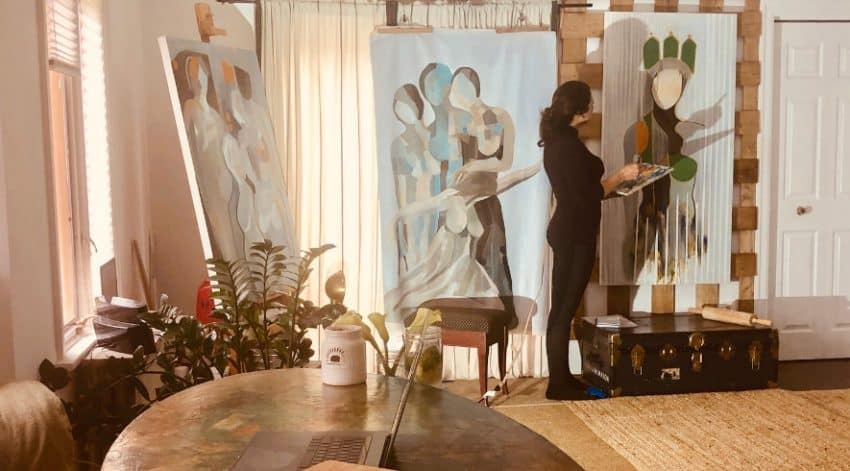
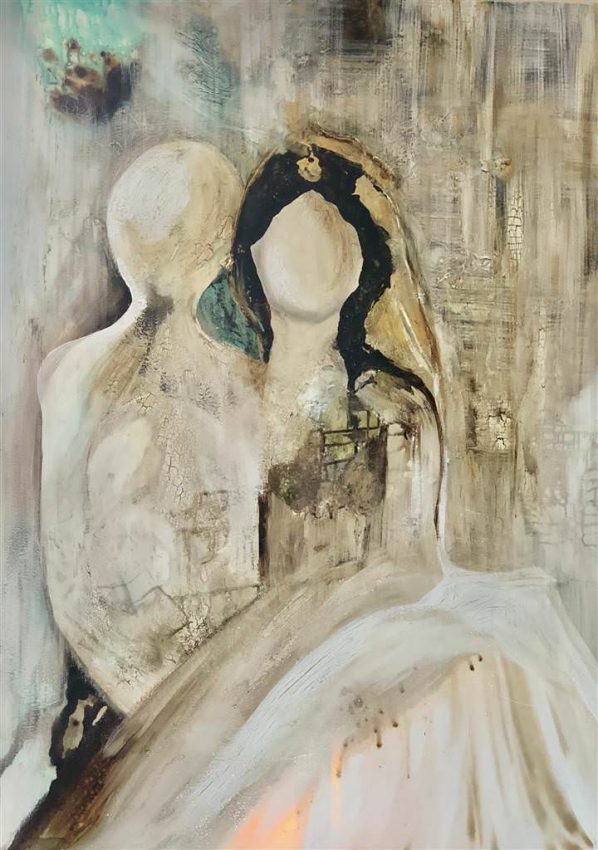
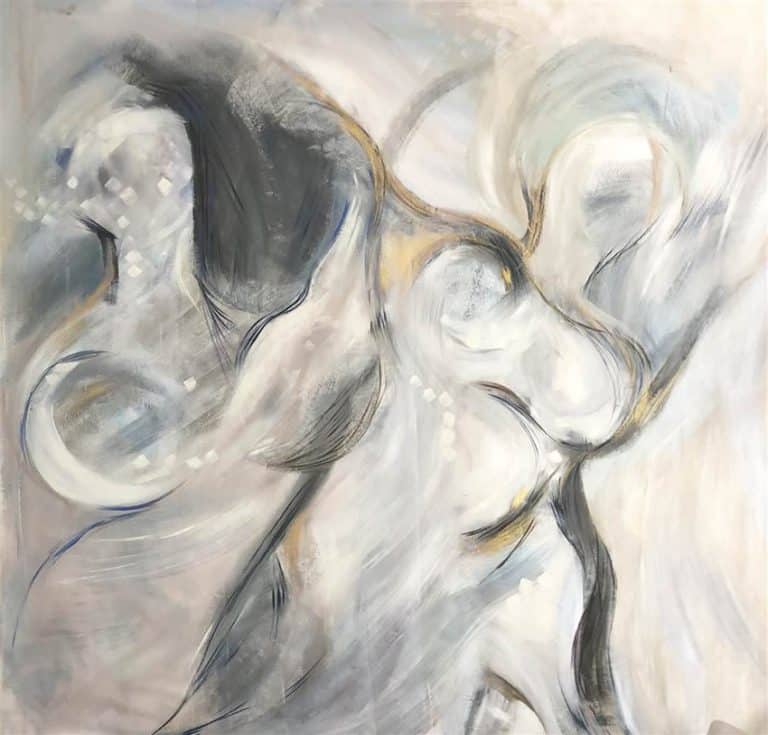
For the Iranian-Canadian artist Fariba Baghi, painting is a space of memory and transformation. Like her subject, she favors organic forms, such as the human body or the landscape. The artist depicts them as nearly weightless and permeated with light. The paint itself, however, does show signs of wear. Baghi says that as she paints, she counts on the paint “growing” and “aging” to eventually reveal the deeper layers underneath.
The tension between the organic quality of her surfaces and the luminous ethereality of the figures she depicts is very important to her work and reflects her complex cultural heritage. She is inspired by the memory of the stark mountainous landscape she saw as a child. The earthiness of her surfaces and her muted but intense pallet contains the energy of this distant land. Baghi is also influenced by Persian mystical poetry, especially that of Rumi and Hafiz.
These great mystics wrote of love as the force that ultimately transforms matter into spirit and establishes a harmonious connection between the individual and the universe. For the artist, the process of painting represents a passage to this higher level of consciousness. Her subjects are in a state of spiritual transformation that unites the organic and the spiritual.
Interview with Fariba Baghi
You reside in Canada but originally hail from Iran, a country with a cultural heritage as ancient as it is rich. Which aspects of your native culture (if any) have played a role in shaping your aesthetic?
The landscape in my country is very different from anything I have seen. We have a lot of deserts and villages that are made of clay in addition to cities and forests. But besides that, the most influential part for me has been the culture and the importance of women, as well as the limitations that exist for them in my country. This issue has given me the most inspiration in portraying women in their different states.
Do you consider yourself an Iranian artist, a Canadian one, or both? How do your Western and Eastern approaches to art meet in your painting?
I consider myself both Iranian and Canadian. Living in both countries has given me the opportunity to experience both cultures and also compare Iran, which is such an ancient country, and Canada, which has a much shorter history.
Some years ago you went through the traumatic experience of losing most of your artwork in a fire. Did this loss affect you as an artist and if so, how?
Losing most of my early paintings was and still is devastating. It is important to be able to see your own process and progression of stages of mind over time, but I don’t have any of my early work to help me do this.
What role did art play in helping you move past this event?
It was very difficult to get over it. I felt lost and I could not concentrate and because of that, I could not pick any subject. My paintings become dark. But as I went through this process I was able to find myself and my track of mind.
Your paintings have an ethereal, airy quality to them. They also have an emotional depth and evoke an association with memory. Could you please describe what inspires you and what you are after in your paintings?
I have always been spiritual, I love Persian poetry, my favorite poets are Molana ( Rumi) and Hafez. Their poetry is characterized by mysticism which gives me inspiration.
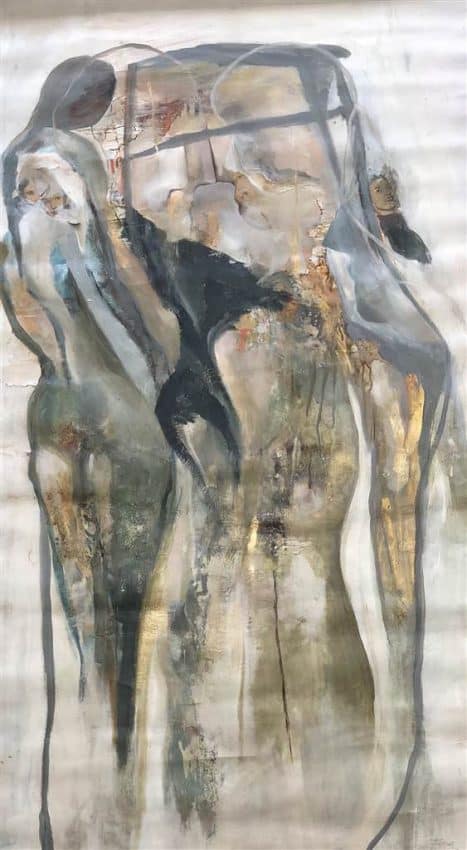
One of your paintings is titled “Schizophrenia.” What inspired this piece? Did a particular experience led to its creation?
Yes, there was a time when I wanted to learn about the illness and to help those who had it. I wanted to understand the way the schizophrenic thinks about and experiences life. So I went to the facility where the patients are kept. They could not leave this facility and spent most of time in their own room. For me, it was very painful to witness this. When I talked to them, I saw that they felt that they couldn’t trust anyone. Actually, they lived with two or more people in their own minds. They were constantly talking to them.
How does the painting speak to this mental illness?
I painted that piece which is about just one person. Since the schizophrenic lives with other people within his own mind, because he thinks too much and is very caring about others, his mind is always busy. Because of this he only becomes more and more sick. I think if they just cared about their own life, it would be much easier.
For people who suffer from mental illness, communication is often a painful and frustrating experience. They encounter a lot of prejudice and fear. In your opinion, is art an effective way to bridge this communication gap?
In my opinion, art in any shape and form is the most effective way to communicate with people, who suffer mental illness because they can create their own interpretation without verbal communication.
Reading through your biography, one sees that loss might be an important theme for you. There is, for instance, the loss of homeland, the loss of the past, and the loss of one’s hold on reality, at least the conventional version of reality. In each instance, there is also a gain: the possibility of a new cultural identity, freedom with respect to what kind of artwork you want to create, and a different, unconventional perspective on how we understand reality, to begin with. Is it correct that these are important themes for you? In your opinion, how does art relate to loss?
Loss results in replacement. It is hard to lose anything that is important to you, regardless of size, shape, and form. However, I learned to see that every time I lost something I ended up finding something new. As hard as losing is, it brings renewal.
Looking to develop your artistic career and build a presence in New York City and worldwide? Book an online career development consultation meeting today.
Read more about Fariba’s work on her ARTmine page as well as her artist profile.
Get the next article and open calls
A few times a year. Unsubscribe anytime.
Questions? Feedback? Thoughts on this article, or a topic you’d like us to cover?